What Is LinkedIn's AI Search Visibility Research?
As AI-powered search experiences become more common, LinkedIn wanted to understand why certain pieces of content are frequently referenced by Large Language Models (LLMs) while others receive little or no visibility. To answer this question, the company conducted internal testing focused on how AI systems identify, interpret, and surface web content.
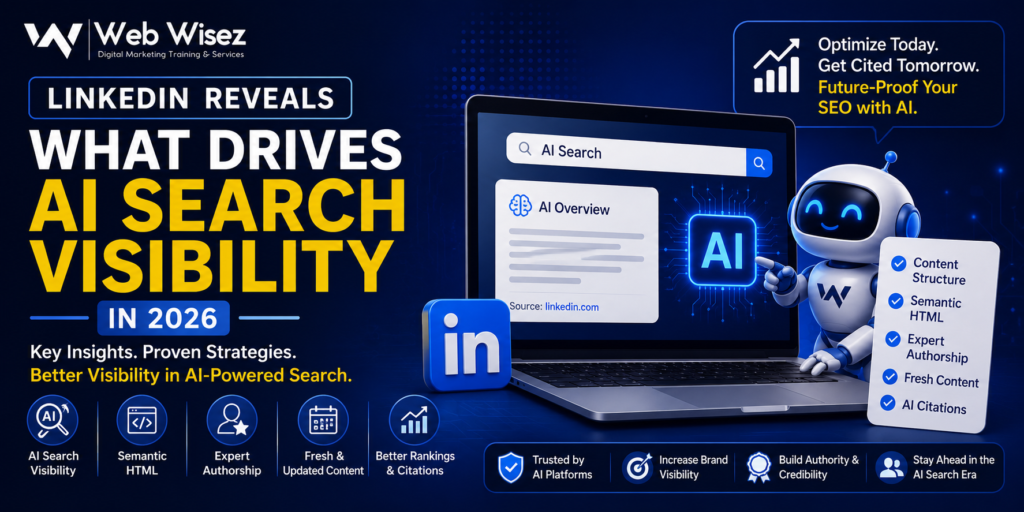
Because LinkedIn is regularly cited by platforms like ChatGPT and other AI assistants, the company had access to valuable data that could reveal what makes content more discoverable in AI-generated responses. The research found that AI models consistently favored content with a logical structure, clear headings, semantic HTML, expert authorship, visible publication dates, and a conversational writing style.
Rather than relying only on keyword optimization, LinkedIn discovered that AI systems prioritize content that is easy to understand and organized in a way that allows information to be extracted quickly. These findings highlight an important shift in SEO strategy. Businesses must now optimize content for both human readers and AI systems, ensuring information is accurate, accessible, and well-structured.
For marketers and website owners, this research provides practical guidance on creating AI-friendly content that can improve visibility across both traditional search engines and modern AI-powered search experiences.As AI search continues to evolve, businesses investing in Digital Marketing Services should adapt their SEO strategies to improve visibility across both traditional search engines and AI-powered platforms.According to the LinkedIn Marketing Blog, structured content, expert authorship, and semantic HTML significantly improve AI Search Visibility.
Why AI Search Visibility Is Becoming Essential
For many years, SEO strategies focused on increasing rankings, attracting organic traffic, and improving click-through rates. While these objectives remain important, AI-powered search is changing how users interact with online information.
Today, millions of people ask AI assistants questions instead of searching through multiple webpages. These AI platforms gather information from trusted sources, summarize it, and present complete answers directly to users. In many cases, users no longer need to visit individual websites to find the information they need.This shift introduces a new opportunity for businesses. Even if users don’t click through to your website, having your content cited by AI platforms can increase brand awareness, strengthen authority, and influence purchasing decisions.Modern SEO Services should focus not only on keyword rankings but also on creating structured, AI-friendly content that earns citations from AI platforms.
Businesses that optimize for AI Search Visibility can benefit from:
As AI search adoption continues to grow, businesses that adapt early will be better positioned to remain visible in an increasingly competitive online environment.
How AI Search Engines Read Website Content
One of the most interesting findings from LinkedIn’s research is that AI systems process content differently from traditional search engines.Search engines typically evaluate an entire webpage, considering hundreds of ranking signals before determining its position in search results. AI models, however, often retrieve smaller fragments of information that directly answer a user’s question.
Instead of reading an entire article from beginning to end, AI systems identify relevant sections such as definitions, FAQs, numbered lists, comparison tables, and concise explanations. This allows them to generate fast and accurate responses.Because of this, websites should avoid publishing large blocks of unstructured text. Every section of an article should have a clear purpose, answer a specific question, and provide information that can stand on its own.Well-organized content makes it easier for AI platforms to understand context, identify key points, and reference your website when generating responses.
Why Content Structure Matters More Than Ever
LinkedIn’s research emphasizes that content structure plays a critical role in AI Search Visibility. Proper organization not only improves the user experience but also helps AI systems understand relationships between topics.One of the simplest ways to improve content structure is by using a logical heading hierarchy.Each page should contain a single H1 heading that clearly defines the topic. Supporting H2 headings should divide the article into major sections, while H3 headings can be used to explain subtopics in greater detail.
This hierarchy creates a clear flow of information, making it easier for both users and AI systems to navigate the content.Short paragraphs are equally important. Instead of writing lengthy blocks of text, each paragraph should focus on one concept. This improves readability and allows AI models to extract information more effectively.
Businesses should also use numbered lists, bullet points, tables, checklists, and FAQs wherever appropriate. Structured formats are easier for AI systems to interpret and often have a greater chance of appearing in AI-generated answers.As AI continues to evolve, well-structured content will become one of the strongest competitive advantages for businesses investing in long-term SEO.
The Role of Semantic HTML in AI SEO
Instead of relying entirely on generic < div > elements, semantic HTML provides valuable context that improves both accessibility and technical SEO.For AI systems, this structured markup makes it easier to distinguish headings, navigation, main content, supporting information, and other important webpage elements. As a result, content becomes easier to interpret and more likely to be extracted for AI-generated responses.Businesses investing in Website Development Services should ensure their websites follow modern semantic HTML standards. Doing so not only improves technical SEO but also prepares websites for the future of AI-powered search.Businesses offering Website Development Services should prioritize semantic HTML to improve website accessibility, technical SEO, and AI readability.Google Search Central also recommends using semantic HTML and structured content to improve website accessibility and search performance.
Why Expert Authorship Builds Trust
Trust has become one of the most valuable signals in AI-generated search results.LinkedIn found that AI systems are more likely to reference content written by real experts with clearly visible credentials. Articles that include author names, professional experience, company affiliations, and publication dates appear more trustworthy than anonymous or undated content.Displaying detailed author information also aligns with Google’s E-E-A-T principles, which emphasize Experience, Expertise, Authoritativeness, and Trustworthiness.
Businesses should create author pages, include professional biographies, and update content regularly to reinforce credibility. These trust signals help AI models determine whether information is reliable enough to reference in generated answers.As AI platforms continue to prioritize authoritative sources, expert authorship will play an increasingly important role in both SEO performance and AI Search Visibility.
Why Content Freshness and Timestamps Matter
LinkedIn’s research also highlighted the importance of publishing fresh, up-to-date content. AI search platforms prefer information that reflects the latest industry trends, especially in fast-changing fields such as SEO, artificial intelligence, digital marketing, technology, finance, and healthcare. Clearly displaying both the publication date and the last updated date helps AI systems determine whether your content is still relevant.
Regularly reviewing and updating existing blog posts with new statistics, screenshots, examples, and insights not only improves the user experience but also increases the likelihood of your content being referenced in AI-generated responses. Businesses that consistently maintain their content demonstrate reliability, which strengthens both user trust and AI visibility.
LinkedIn's New AI Visibility Metrics
One of the biggest takeaways from LinkedIn’s research is that traditional SEO metrics alone are no longer enough to measure content performance. Organic traffic, rankings, and click-through rates remain important, but they don’t capture how AI platforms are using and citing your content.
To better understand AI performance, LinkedIn has introduced new visibility metrics alongside traditional analytics. These include Citation Share, Visibility Rate, LLM Mentions, and AI Referral Traffic. Citation Share measures how frequently LinkedIn content is referenced in AI-generated responses. Visibility Rate indicates how often content appears when AI platforms answer user queries. LLM Mentions track brand references across Large Language Models, while AI Referral Traffic helps identify visitors arriving from AI-powered search experiences.
These new measurements reflect the future of SEO. Instead of focusing only on traffic, businesses should also monitor how often their content is discovered, referenced, and trusted by AI systems.
Practical AI SEO Best Practices
LinkedIn’s findings provide several actionable recommendations that businesses can implement immediately to improve AI Search Visibility.Start by creating content that answers user questions clearly and directly. AI systems prefer concise explanations that provide immediate value rather than long introductions filled with unnecessary information.
Use a logical heading hierarchy throughout every article. A single H1 heading followed by descriptive H2 and H3 headings helps AI understand how topics relate to one another.Write naturally for people first. Conversational language is easier for both readers and AI models to understand. Avoid keyword stuffing and focus on providing practical, accurate information.
Implement semantic HTML across your website to improve technical SEO and AI readability. Using meaningful HTML elements allows AI systems to interpret webpage structure more effectively.Display author information, credentials, publication dates, and updated timestamps to strengthen trust signals. AI models increasingly prioritize content from identifiable experts.Update older blog posts regularly to ensure information remains accurate and relevant. Fresh content has a higher chance of being surfaced by AI platforms.Finally, strengthen your website’s internal linking structure. Connecting related pages helps search engines and AI models understand your website architecture while improving user navigation.A strong Content Marketing Services strategy helps businesses create valuable, well-structured content that both users and AI systems can easily understand.
AI Search vs Traditional SEO
Although AI Search Optimization introduces new ranking opportunities, traditional SEO remains essential. The difference lies in how content is discovered and measured.Traditional SEO focuses primarily on keyword rankings, backlinks, website traffic, and click-through rates. AI Search Optimization focuses on content quality, structured information, credibility, citations, and how easily AI systems can understand and extract information.
Instead of competing only for the top position on a search engine results page, businesses are now competing to become trusted sources that AI platforms choose to reference. This means SEO strategies should evolve to include structured content, semantic HTML, expert authorship, and helpful answer-focused writing.The future belongs to businesses that successfully combine traditional SEO best practices with AI-focused optimization strategies.AI-powered search platforms like Perplexity AI retrieve concise and well-structured content to generate accurate responses for users.
What This Means for Businesses
The rise of AI-powered search is reshaping digital marketing. Businesses that continue relying solely on traditional SEO techniques may struggle to maintain visibility as user behavior changes.Organizations that publish high-quality, well-structured, and trustworthy content will have a significant advantage. AI systems increasingly prioritize content that demonstrates expertise, provides accurate information, and follows a logical structure.
For businesses, this means investing in content quality rather than simply producing large volumes of articles. Every page should provide genuine value, answer real user questions, and establish authority within its subject area.Companies that begin optimizing for AI Search Visibility today will be better positioned as AI-generated search experiences continue to expand across Google, ChatGPT, Perplexity, Gemini, and other platforms.
Final Thoughts
LinkedIn’s latest AI Search Visibility research provides valuable insights into the future of SEO. The findings clearly demonstrate that content structure, semantic HTML, expert authorship, publication dates, and credibility all influence whether AI systems choose to surface your content.As AI continues transforming the search landscape, businesses should move beyond simply optimizing for rankings. The goal is no longer just to appear in search results—it is to become a trusted source that AI platforms confidently reference when answering user questions.
At Web Wisez, we believe successful SEO strategies must evolve alongside emerging technologies. By creating structured, high-quality, and AI-friendly content, businesses can improve their visibility across both traditional search engines and modern AI-powered platforms.The future of SEO isn’t about choosing between Google and AI search—it’s about optimizing for both. Businesses that embrace this shift today will be better prepared for tomorrow’s digital landscape.If you’re looking to build expertise in modern SEO and AI search optimization, explore our Digital Marketing Course in Chennai and learn industry-ready strategies from experienced professionals.